
GAMP Services Limited
  • Our Company
    • About Us
    • Contact Us
  • Services
    • Thermal Validation
    • Commissioning, Qualification & Validation
    • Clean Room Validation
    • Computer System Validation & Data Integrity
    • Bio-Decontamination
  • Manufacturing
    • Data Logger
  • Industries
    • Life Science
    • Pharmaceutical
    • Medical Devices
    • Food & Beverages
    • OEM, Testing & Third-party Validators
    • High-Tech
    • Semiconductor
    • Electrical, Electronics & Mobile
    • Aerospace & Defence
    • Automobile, EV, Battery & Renewables
  • Distribution
    • Thermal Validation
    • Cleanroom Monitoring
    • Biodecontamination
    • Tracer Particle Generator
    • Process Analytical Tools (PAT)
  • Resources
    • News
    • Knowledge Centre
  • Investor Relations
    • Governance
    • Board of Directors
    • Key Managerial Personnel (KMP)
    • Composition of Committees
    • Policies
    • Our Group
    • Our Subsidiaries
    • Group Companies
    • Disclosures
    • Annual Report
    • Annual Return
    • Memorandum of Association (MOA)
    • Articles of Association (AOA)
    • Public Offer
    • IPO
    • Offer Documents
Knowledge Centre
Knowledge Centre
  1. Home
  2. Knowledge Centre
  3. Blogs
  4. Semiconductor cleanroom monitoring is not pharma monitoring
High-Tech Industries

Semiconductor cleanroom monitoring is not pharma monitoring

Smaller particles, tighter classes and molecular contamination. Why a pharma-style monitoring plan falls short in a fab.

Gaurav Shah 28 Aug 2026 3 min read
Semiconductor cleanroom monitoring is not pharma monitoring
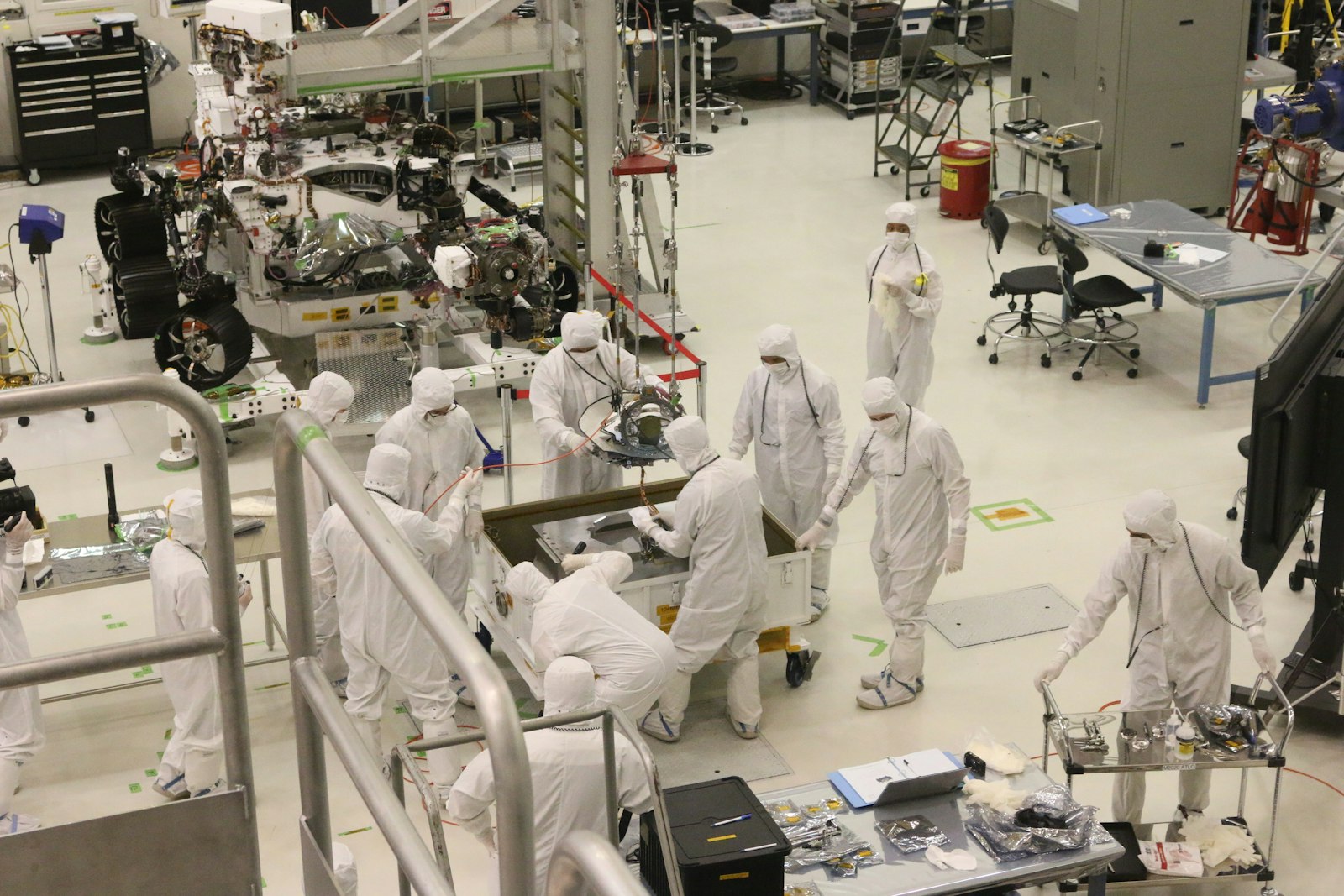
Photo: Laurel and Michael Evans on Unsplash
On this page What is being protected Particle sizes Airborne molecular contamination The rest of the environment What the data is for
Related service Semiconductor Learn more

India's semiconductor projects are bringing a lot of engineers into fab construction who learned cleanrooms in pharma. The vocabulary is the same: ISO classes, HEPA and ULPA filters, particle counters, pressure cascades. The priorities are not. A monitoring plan that would satisfy a pharma inspector can miss most of what matters to a fab's yield.

What is being protected

In a pharma cleanroom, the main concern is the patient. Monitoring is built around sterility assurance: viable organisms, and the particles that might carry them. Limits are set by GMP and the classes stop at ISO 5.

In a fab, the concern is the wafer. A particle that lands on a pattern a few tens of nanometres wide can kill a die. Contamination is measured in yield lost, and the standard is set by the process, not by a regulator. Critical areas run at ISO 1 to ISO 3, and the most critical spaces are no longer rooms at all but minienvironments: sealed wafer carriers and equipment front-end modules with their own filtered air.

Particle sizes

Pharma monitoring counts at 0.5 µm and 5 µm. In a fab, those sizes are almost irrelevant in the critical zones. Counters sized at 0.1 µm are common, and condensation particle counters are used where particles in the tens of nanometres need to be seen. The 5 µm channel that pharma sites argue about rarely registers anything in an ISO 3 space.

Airborne molecular contamination

This is the biggest difference, and the one most often missed. Molecules that a particle counter cannot see, acids, bases, organic compounds and dopants, can react with wafer surfaces, haze optics in lithography tools or change the electrical properties of a device. ISO 14644-8 gives a way of classifying cleanroom air by these chemical families.

AMC is monitored at concentrations of parts per billion and below, with dedicated instruments or sampling and laboratory analysis, at the points the process engineers care about most: lithography bays, around open wafers, and at the make-up air intake.

A typical gapThe particle monitoring is excellent, and the AMC plan is a line in the commissioning document that says "to be decided". Decide it before the tools arrive. Some contamination sources are construction materials, and they are easiest to fix before the room is finished.

The rest of the environment

  • Temperature and humidity are controlled far more tightly in lithography areas than any pharma room, often to a fraction of a degree and around one per cent relative humidity.
  • Vibration matters for metrology and lithography tools, and is part of the facility specification.
  • Electrostatic discharge control is a monitoring item in its own right.
  • Microbiology, the core of pharma monitoring, is usually not monitored at all.

What the data is for

A pharma site reviews monitoring data for compliance: was the limit met? A fab uses it for process control. Particle and AMC data are trended alongside defect inspection and yield data, so that an increase in a particular defect can be traced to a tool, a bay or a time. That changes how the system should be designed: more points, often through manifold sampling systems, tighter time synchronisation with production records, and software that can talk to the fab's own data systems.

None of this makes pharma experience less useful. Discipline about cleaning, gowning, airflow and documentation carries straight across. It is the measurement plan that needs to be rebuilt around the wafer.
GS Written by Gaurav Shah, GAMP Services Limited.
Keep reading

Related articles

View all
Battery dry rooms: holding the dew point at −40 °C and below High-Tech Industries 24 Sep 20263 min read Battery dry rooms: holding the dew point at −40 °C and below Why lithium-ion cell lines care so much about moisture, and what to measure when you qualify a dry room. Read more Continuous particle monitoring in Grade A after the 2022 Annex 1 Environmental Monitoring 14 Oct 20264 min read Continuous particle monitoring in Grade A after the 2022 Annex 1 Where the probes go, how alarms should be set and what to do with the 5 µm channel now that Annex 1 is in force. Read more Steam sterilizer validation: Bowie-Dick, heat distribution and heat penetration Thermal Validation 9 Oct 20264 min read Steam sterilizer validation: Bowie-Dick, heat distribution and heat penetration What each test on a porous-load autoclave tells you, and the mistakes that send a qualification back for a repeat. Read more

Talk to our team

Talk to us about your next validation or monitoring project.

Contact Us LinkedIn

Our Business

  • Services
  • Manufacturing
  • Distribution
  • Industries

Services

  • Thermal Validation
  • Commissioning, Qualification & Validation
  • Clean Room Validation
  • Computer System Validation & Data Integrity
  • Bio-Decontamination

Company

  • About Us
  • Investor Relations
  • News
  • Knowledge Centre
  • Contact Us
copyrightGAMP Services Limited 2026. All Rights Reserved.
Privacy Policy Terms of Use