

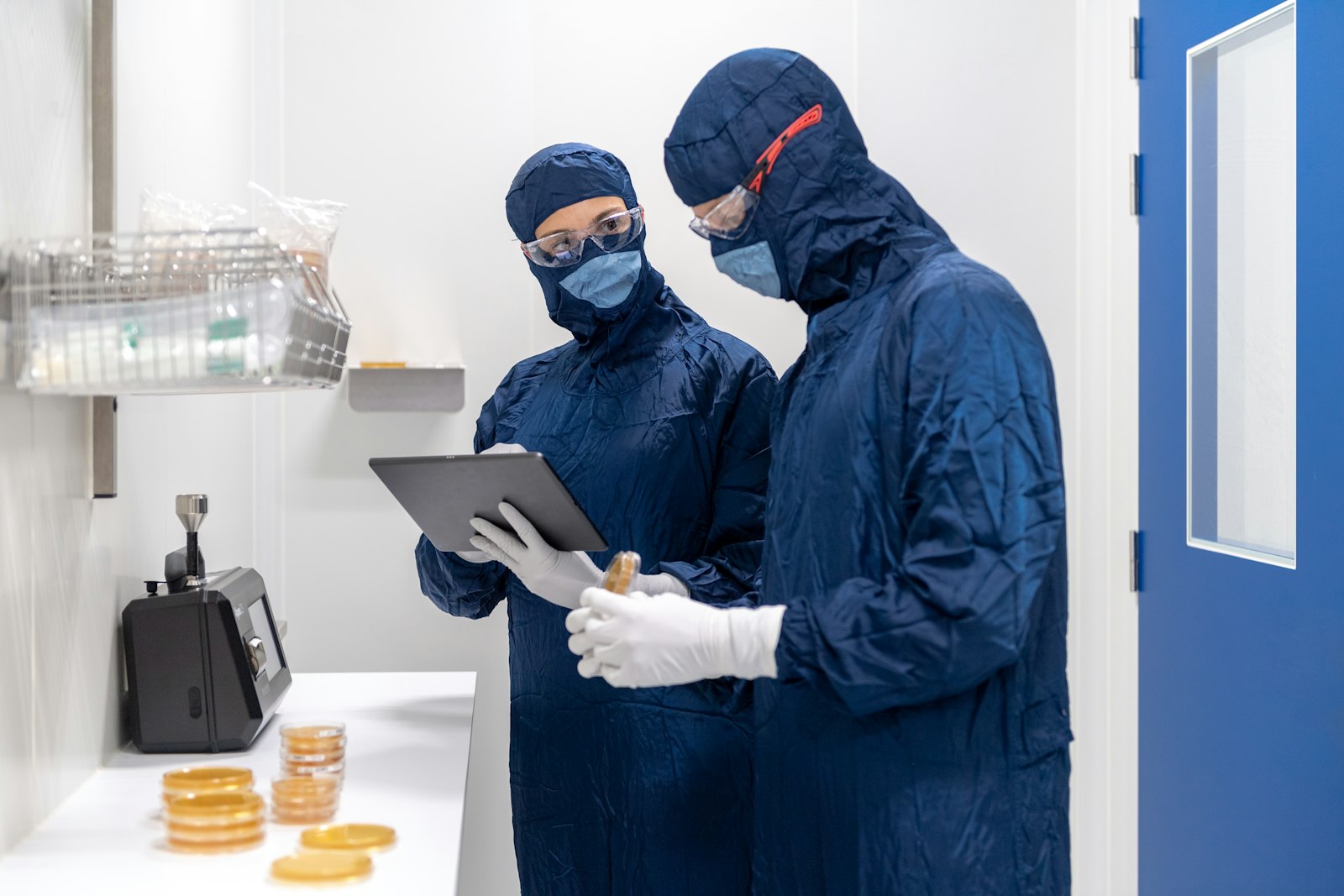
When the revised EU GMP Annex 1 came into force in August 2023, most sites already had a particle counter running in their filling line. What changed was the expectation around it. Monitoring in Grade A is no longer something that happens next to the process. It is part of the contamination control strategy, and an inspector will ask you to explain every choice behind it: why the probe is there, why the alarm is set at that level, and what happens when it goes off.
This piece goes through the questions we hear most often when a site reviews its Grade A monitoring against the new text.
What the 2022 text actually asks for
For Grade A, Annex 1 expects continuous monitoring of total particles for the full duration of critical processing, including equipment assembly. That last part catches people out. If operators assemble the filling needles or stopper bowl under the Grade A zone, the counter should already be running.
The limits themselves are familiar. For Grade A, the 0.5 µm limit is 3,520 particles per cubic metre, at rest and in operation. The 5 µm limit is the one that changed. The table now says "not specified" for Grade A and for Grade B at rest, but the text still expects you to monitor the 5 µm channel, because a run of counts at that size can point to a real problem with the process or the equipment even when the class limit is met.
Choosing probe positions
Probe positions should come out of a risk assessment, and the assessment should be written down. Sample as close as practical to the point where product or open containers are exposed, without the probe or its tubing disturbing the unidirectional airflow. The FDA's 2004 aseptic processing guidance puts a number on it, no more than about 30 cm from the work site, and most sites use that as their working rule.
Annex 1 also sets a minimum sample flow of 28.3 litres per minute (one cubic foot) for Grade A, so that short events are not missed between samples.
In practice that means looking at a few things together:
- Where open containers, stoppers and the product path are exposed, and for how long.
- What the smoke study showed about airflow at those points, especially during interventions.
- Where operators put their hands and arms, both for routine work and for corrective interventions.
- Whether the probe position can be cleaned and does not create a shadow in the airflow.
Isokinetic sampling heads are worth the effort in unidirectional airflow. A non-isokinetic head facing the wrong way can under-count larger particles, and the 5 µm channel is exactly where that shows.
The tubing problem
Remote counters and vacuum systems usually sit outside the Grade A zone, with tubing running to the probe. Long tubing loses particles, mostly the larger ones, through settling and bends. ISO 21501-4 does not cover the tubing, so the transport loss is your responsibility.
Keep the tube as short as possible, avoid tight bends, and if the run is more than a couple of metres, test the transport efficiency for the 5 µm size. It is a quick test and it saves an argument during an inspection.
Setting alert and action levels
Action limits normally follow the Annex 1 limits. Alert levels are where sites have room to think. They should be based on your own historical data, not copied from the action limit or from another site.
Annex 1 also asks you to watch for trends, not only single excursions. A useful approach is to define an alert for a number of consecutive or frequent counts above a lower threshold, so that a slow drift is noticed before it becomes an action-level event. Short spikes caused by interventions are worth tagging in the monitoring software at the time, so the investigation later has the context.
Alarms, data and what happens next
The monitoring system has to raise an alarm the operators can see and hear in the room, not just on a screen in the QA office. Every alarm needs a documented response: who stops, who assesses, and when the batch record is annotated.
On the data side, the system is a GMP computerised system like any other. Audit trails, user access, time synchronisation and backup all need to be in place and validated. A quick check we suggest to every site: compare the timestamps in the monitoring software with the batch record for one recent intervention. If they disagree by minutes, it will be noticed.
A short review checklist
- Monitoring starts before equipment assembly in Grade A, not at the start of filling.
- Probe positions are justified in a written risk assessment that refers to the smoke study.
- The 5 µm channel is monitored and trended, even though Annex 1 has no limit for it in Grade A.
- Tubing transport efficiency has been checked where the run is long.
- Alert levels come from your own data and are reviewed at least once a year.
- Alarms are visible in the room and have a written response.
- The monitoring software is validated, with audit trails and synchronised time.
None of this needs new equipment in most cases. It needs the reasoning to be written down, and the data to be looked at regularly.

 GAMP Services Limited 2026. All Rights Reserved.