

GAMP Services Limited
  • Our Company
    • About Us
    • Contact Us
  • Services
    • Thermal Validation
    • Commissioning, Qualification & Validation
    • Clean Room Validation
    • Computer System Validation & Data Integrity
    • Bio-Decontamination
  • Manufacturing
    • Data Logger
  • Industries
    • Life Science
    • Pharmaceutical
    • Medical Devices
    • Food & Beverages
    • OEM, Testing & Third-party Validators
    • High-Tech
    • Semiconductor
    • Electrical, Electronics & Mobile
    • Aerospace & Defence
    • Automobile, EV, Battery & Renewables
  • Distribution
    • Thermal Validation
    • Cleanroom Monitoring
    • Biodecontamination
    • Tracer Particle Generator
    • Process Analytical Tools (PAT)
  • Resources
    • News
    • Knowledge Centre
  • Investor Relations
    • Governance
    • Board of Directors
    • Key Managerial Personnel (KMP)
    • Composition of Committees
    • Policies
    • Our Group
    • Our Subsidiaries
    • Group Companies
    • Disclosures
    • Annual Report
    • Annual Return
    • Memorandum of Association (MOA)
    • Articles of Association (AOA)
    • Public Offer
    • IPO
    • Offer Documents
Knowledge Centre
Knowledge Centre
  1. Home
  2. Knowledge Centre
  3. Blogs
  4. Reading a particle counter calibration certificate (ISO 21501-4)
Environmental Monitoring

Reading a particle counter calibration certificate (ISO 21501-4)

Counting efficiency, size resolution, false counts. The six numbers on the certificate that matter, and what good looks like.

Manish Patel 13 Aug 2026 3 min read
Reading a particle counter calibration certificate (ISO 21501-4)
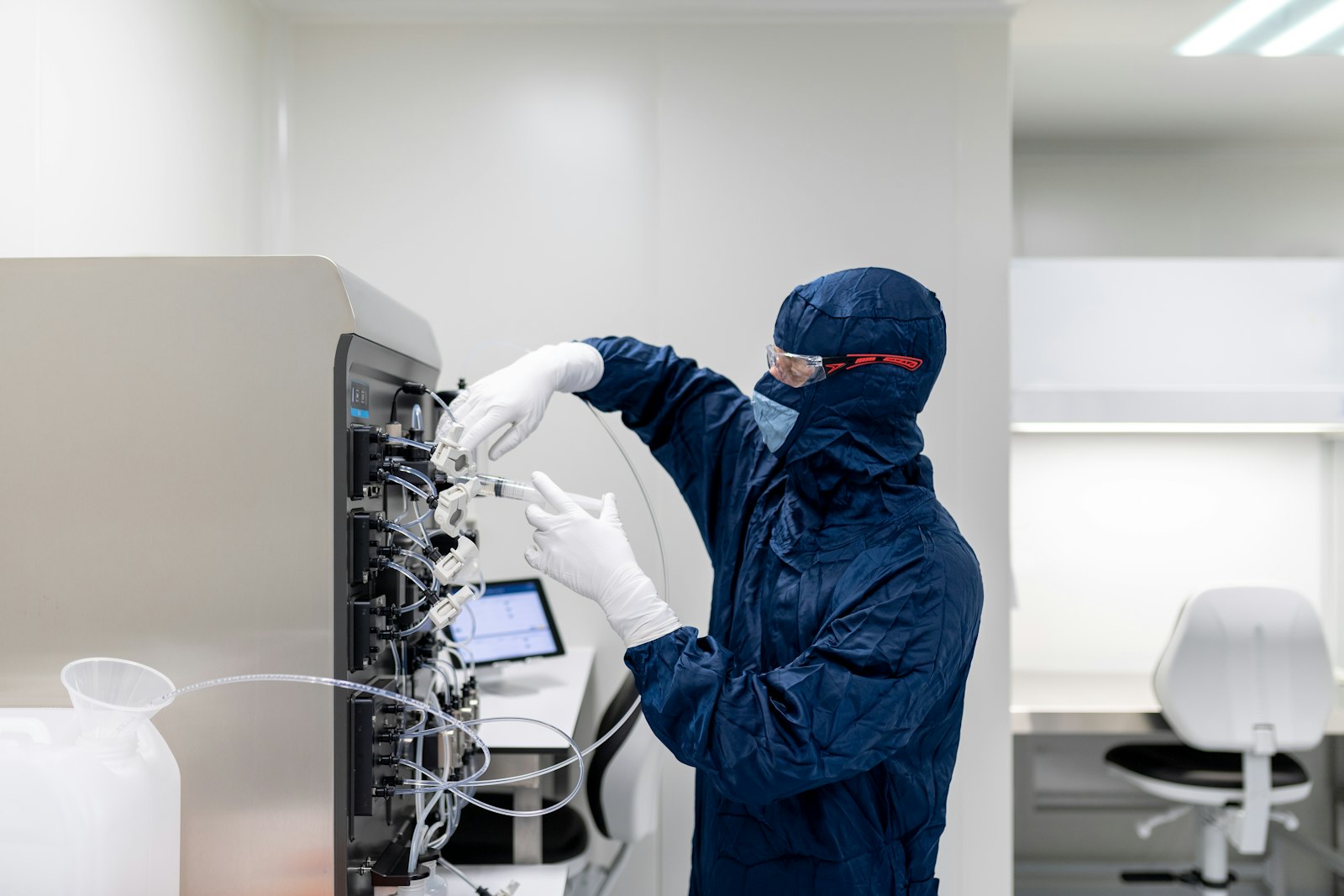
Photo: Toon Lambrechts on Unsplash
On this page Size setting Counting efficiency Size resolution False count rate Flow rate and sampling time Maximum concentration As found, as left How often
Related service Cleanroom Monitoring Learn more

Every particle counter used for cleanroom classification or monitoring needs a calibration certificate, and most of those certificates get filed without anyone reading past the first page. That is a shame, because the certificate tells you whether the counter can actually be trusted to do the job. ISO 14644-1 requires counters used for classification to be calibrated to ISO 21501-4, and that standard defines what a proper calibration has to check.

Here are the items worth reading, and what a good result looks like.

Size setting

The counter sorts particles into size channels by how much light they scatter. Calibration checks that the channel thresholds are set correctly, using reference particles of known size, usually polystyrene latex spheres. If the 0.5 µm channel is set too high, the counter under-counts and a room can look cleaner than it is.

Counting efficiency

This is the ratio of particles the counter reports to the particles actually present, measured against a reference instrument. ISO 21501-4 sets two checks:

  • At the smallest size the counter claims to detect: 50 % ± 20 %.
  • At a size of 1.5 to 2 times the smallest size: 100 % ± 10 %.

The first figure surprises people. It reflects how the minimum detectable size is defined: it is the size at which the counter sees about half of the particles. That is why a counter rated at 0.3 µm is a good choice for counting at 0.5 µm, where it should be close to fully efficient.

Size resolution

Size resolution describes how cleanly the counter separates particles of nearby sizes. The requirement is 15 % or better at the specified size. A counter with poor resolution smears counts across channels, which matters when your limits are set on one channel.

False count rate

With a filter on the inlet, the counter should report almost nothing. Counts in clean air come from electronic noise or internal contamination. This matters most in Grade A and ISO 5 areas, where real counts are low and a few false counts per cubic metre can push a result over an alert level.

A quick check between calibrationsA zero count with a purge filter on the inlet takes a few minutes and catches a contaminated optical chamber early. Many sites do it before every classification.

Flow rate and sampling time

The counter converts counts into a concentration using its flow rate. If the flow is off by 10 %, the concentration is off by 10 %. ISO 21501-4 allows a tolerance of ± 5 % on the sampling flow rate, and the certificate should show the as-found and as-left values.

Maximum concentration

At high concentrations, two particles can pass through the beam together and be counted as one. The certificate states the concentration at which this coincidence loss reaches 10 %. For Grade C and D rooms in operation, check that your expected counts are comfortably below it.

As found, as left

A good certificate shows results before any adjustment as well as after. If the as-found values were out of tolerance, every measurement made since the last calibration may be affected, and that needs to be assessed. A certificate that only shows the as-left values hides exactly the information you need.

How often

ISO 21501-4 recommends calibration at least once a year. Counters in heavy use, or those moved often between rooms, may justify a shorter interval, especially if the as-found results show drift.

MP Written by Manish Patel, GAMP Services Limited.
Keep reading

Related articles

View all
Continuous particle monitoring in Grade A after the 2022 Annex 1 Environmental Monitoring 14 Oct 20264 min read Continuous particle monitoring in Grade A after the 2022 Annex 1 Where the probes go, how alarms should be set and what to do with the 5 µm channel now that Annex 1 is in force. Read more Steam sterilizer validation: Bowie-Dick, heat distribution and heat penetration Thermal Validation 9 Oct 20264 min read Steam sterilizer validation: Bowie-Dick, heat distribution and heat penetration What each test on a porous-load autoclave tells you, and the mistakes that send a qualification back for a repeat. Read more ISO 14644-1 classification: how many sampling locations does your room need? Clean Room Validation 5 Oct 20263 min read ISO 14644-1 classification: how many sampling locations does your room need? The 2015 revision replaced the square-root rule with a look-up table. Here is how to use it without over- or under-sampling. Read more

Talk to our team

Talk to us about your next validation or monitoring project.

Contact Us LinkedIn

Our Business

  • Services
  • Manufacturing
  • Distribution
  • Industries

Services

  • Thermal Validation
  • Commissioning, Qualification & Validation
  • Clean Room Validation
  • Computer System Validation & Data Integrity
  • Bio-Decontamination

Company

  • About Us
  • Investor Relations
  • News
  • Knowledge Centre
  • Contact Us
copyrightGAMP Services Limited 2026. All Rights Reserved.
Privacy Policy Terms of Use